Showing posts with label landscapes. Show all posts

20 December 2014

Winter Solstice Eve


winter pond

snow fields

New England Barn

snow rose

North Canton Horse Farm

winter passion

Blessings on this eve
of Winter Solstice


04 October 2014

What's on the Horizon?

It's been awhile since I've posted anything. My bad, but summer is a tough time. Life just seems to gravitate to the outdoors, and I'm reluctant to come inside and sit in front of my computer and scanner and post images, thoughts, etc. 

But as the light begins to shift and autumn starts to roll in, to come inside -- especially on a day when it's drizzly and damp -- is not such a chore, is it? So as I started to sort and re-organize my space for the 'indoor season' I found some works from last winter, still resting on the easels, waiting patiently for me to notice them. 

Your works do become a kind of family, images filled with memories of contentment or frustration, eagerness, curiosity and yes, sometimes anger. However, I have good memories of these two -- both started out as something else; both were re-worked over other 'failures' with oil, cold wax (Dorlands) and bits of pastel (Sennelier).

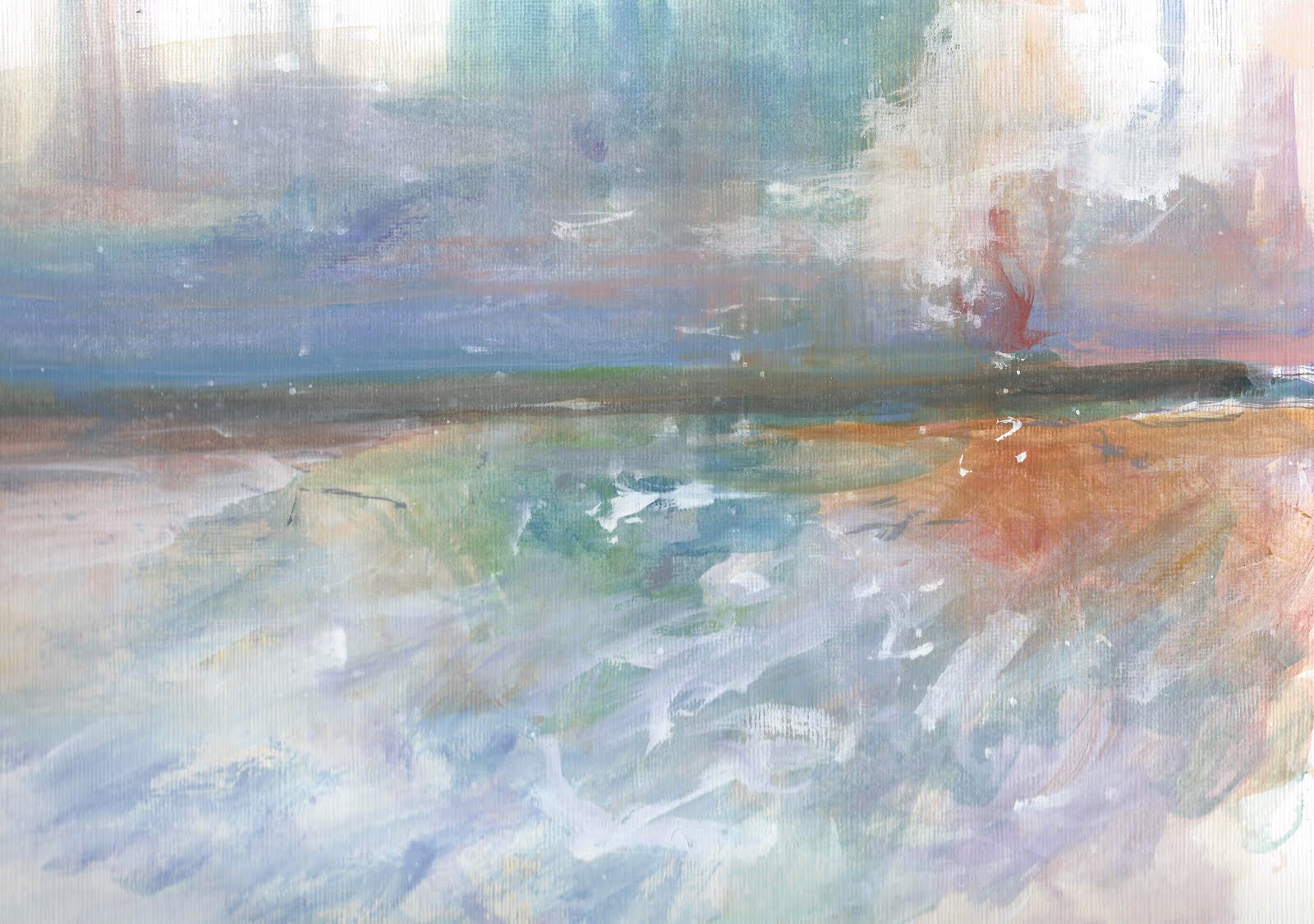
Horizon1 (detail) (oil, wax, pastel; 10"x24")

There's something about the horizon line and bodies of water that intrigue me, whether I'm on the Cape or traveling through the farmlands of New England. These past weeks I pass field upon field of corn mowed down and bundled into rolled stacks, not unlike Monet's "Haystacks." 

As the late afternoon sunlight moves across the land, it is breathtaking. You want to slam on the brakes and capture the shadows and light, the dimming colors of hay and pine against cloud-laden skies.
 
Horizon2 (detail) (oil, wax, pastel; 10"x24")

These are partial scans of the larger work, too big to scan as a whole.  Each measures 10" x 24" and is painted on a birch panel, which I love more and more as I work on them.  They take a good deal of abuse, as I tend to use brayers rather than brushes, continually applying bits of paper toweling to remove paint, then add another layer, remove, add. During this process I also use the edge of the brayers to create marks that then reveal the layers below, a kind of construction/deconstruction process, and the panels hold up well.

I hope to continue this "Horizon" series on panels of varying sizes. I've always wanted to do a triptych or diptych, and I think the birch panels would work as you could clamp or screw the panels together.  One more note on this process:  depending on what brand toweling you use (or napkins), the brayer will often pick up the pattern ever so slightly, which makes for another layer of texture -- pretty cool!


We are enveloped and drenched in the marvelous, but we do not see. 
Baudelaire


10 August 2014

Seasons of Light

Does the season dictate what we paint?  Or is it the play of light and shadow?  Or both?   These are small sketches I did over the past year -- some were painted in the winter/early spring in my travels up through Massachusetts, Vermont and New Hampshire --  

Late Sun on Snowfields (mixed media; 8"x10")

Distant Mountains (mixed media; 8" x10")

While these were painted earlier this summer at the Cape --

Sand Dunes and Marshes (watercolor; 5" x7")

Cape Light (watercolor; 5" x 7")

Tracking the Sun (watercolor; 5" x 7")

Why landscapes and at other times abstracts?  I'm beginning to think that it may have much to do with the light.  In the winter and autumn, the light plays across the land, catching out colors and contours.  While in the summer, one often can't even see the land because your sight is overwhelmed with the intense light and the heat waves shimmering off the surfaces of water, sand and marshes.

Now I'm watching the late afternoon skies more often, noting the lowness of the sun, the cast of shadows stretching just a bit more across the gardens and lawns.  Temperatures have dropped at dusk and there's the need for a sweater or light jacket.

We have moved from the pastels of spring to the intense yellows and reds of late summer.  In a few weeks, the persimmons and ambers of autumn will take their place, along with the smell of woodsmoke and hot cocoa.  

But for now I'll take what I see, shift my toes in the cool grass and sip at a glass of chilled white wine while I splatter paints across the blank white page . . . 


In nature, light creates the color. In the picture,
color creates the light. 
Hans Hofmann 


02 August 2014

Slow summer painting


A world of color and hue, 
 a world that remembers the nuance of light and shadow, 
of how darkening waters still send up a glitter,
a spark of sunlight, 
  a world quiet but for birdsong drifting on air . . . 


Sometimes the brush works with you, sometimes not. 
Another layer of paint, 
 scrap back, 
begin again. 
Losing track of time -- is it day or is it night? 
Does it matter? 

Muscles begin to ache,
fingers cramp.

Has it been that long?
Must be.

The body needs time
to adjust,
not to fight the flow,
to corral the brushwork.

Slip aside,
step back,
surrender . .  . 


14 October 2013

Autumn Haze

Columbus Day weekend, that lovely 3rd day off at the height of the autumn season -- a wonderful time of year! Today a haze of gold -- I can't think of a better way to describe it -- has softened the sunlight and the gardens and pathways are dappled with the leaves that are falling each moment.

Going through some sketches from the past months, I found these -- simple watercolors, no great detail or angst went into them. But I tend to like them, as their "sketchiness" seems to match the season. 

Small Pond, New Hampshire

As I travel back and forth to work or on a weekend jaunt, I pass so many ponds and small lakes, not to mention the beautiful Connecticut River. In the late afternoon on my way home, I drive the back roads to avoid commuter traffic, passing farms and old barns, even a vineyard or two. 

I love the way the sunlight hits the side of a farmhouse, striking the old, worn sideboards in a dazzling white against the autumn maples and dark green pines. 

Berkshire Barn

And then the sun begins to dip below the treeline. I know in a few weeks I won't even be able to see the sun on my way home, as it will be twilight by that time. 

So, for now, I relish that lovely dusk sky, flooded with rose and peach and lavender, when the light is riding the rim between day and night and all seems hushed.

Dipping Sun, East Weatogue

In nature, light creates the color. In the picture, color creates the light. 
Hans Hofmann

*   *   *

in just one breath
last leaf falls
skies open wide

[haiku by artist]

07 July 2013

Summer Sketches


So, back from the week at the Cape, recharged and ready to create -- except that July has hit with 95+ degree weather and humidity that weighs you down like a load of wet sand -- ugh! Just two small 8" x 8" watercolor sketches; I did do others but even smaller (2.5 x 4). 

I think that these two somehow capture a sense of atmosphere, of simple shapes and times of day.  Perhaps, maybe not.  Watercolor does seem to capture one's impressions quickly and, at this size, it's difficult to even try to get any definitive details, especially when using a fairly large brush.

Not terribly interested in detail or photographic reality; more an essence of place and time of day.


Although on this one my husband exclaimed, "Oh, look! An atomic blast!" Ha, ha, very funny . . . well, I suppose it does look a bit like that. 

But with this long holiday weekend, I did work on some new oil paintings, again trying to capture a sense of light, of shapes and patterns rather than traditional land/seascapes. Also, tried to work from memory rather than photos taken on cellphones, etc.  Under the extreme brightness of Cape light, details tend to disappear, things shimmer and fade, then come into greater clarity before disappearing altogether.  Think about when you lie on the beach on your stomach and look down the sand at the people and the water and the light -- more like a chimera than anything!

As soon as they are dry, I'll try to take some pics; however, I may spring for a professional to do that as they are too big to scan. My time is a bit crunched these days and patience is wearing thin to be fiddling around with cameras and tripods.

17 February 2013

Painting from Photos and Memory

"The light of memory, or rather the light that memory lends to things, is the palest light of all. . . . I am not quite sure whether I am dreaming or remembering, whether I have lived my life or dreamed it.
 Eugène Ionesco 
 
CT River, Late Autumn

Still working on the river and coastline oils -- at this time of year I'm depending upon the many photos I've taken over the years along the Connecticut, Massachusetts and Maine coastlines; also depending upon my memories of driving the CT River for over 15 years. 

However, the more I work on these coastline / river paintings, I seem to be concentrating on the skies and the breaking light rather than the actual waters. So much does depend upon the light, though. A ho-hum gray day can become quite dramatic when the cloud cover breaks and a shaft of sunlight splits the skies. 


Departing Clouds


Or perhaps it's a battalion of clouds scudding across the horizon after a storm, giving an ominous look to everything.

Well, we're not too far from Daylight Savings Time and Spring -- hooray!  After last week's blizzard, I have had enough of winter, although I admit that winter does afford one the time to work, paint, collage, quilt, knit inside.  Once spring arrives, the gardens will need tending, raking out, transplanting, etc.  And so the painting tends to take a back seat during those weeks.

But my plan is to get outside more and paint -- I re-joined the CT Plein Air Painters [I had let that lapse last year with the new job] and am hoping that will give me the incentive to get out there and paint from the real thing, not simply photos and memory.


Beach Cottages in Fog, the Cape

That's the plan -- but then the deck and the gardens tend to keep me close to home once the hard work has been done.  Ah, well --  I suppose I can always paint my garden!   Like Monet, I will sit amidst the roses and clematis with my battered straw sun hat and revel in the scents and colors of summer. 

Sounds like a plan to me . . . :-)


21 January 2013

A Sense of Place

There are some places that live with us. Perhaps we grew up in these special spaces; perhaps we live in them currently. They become a part of our psyche, like a silent tapestry that abides within . . .

For me, it is the oceans, rivers and lakes of the Northeast. I grew up on eastern Long Island and could walk to the beach from my house. My husband and I, when we were dating, spent most of our free time at the beach. Every summer we head for Cape Cod and our children, now grown, follow in the familiar path to the Cape.

Every autumn we head north to Maine and walk the coastline, drinking in the wide open spaces, the quicksilver skies. On my daily commute I pass along the CT River and witness amazing turns of light and of seasons.

These sketches and paintings are my attempts to capture those moments . . .


Encroaching Storm [watercolor and gouache]


Spindrift, West Dennis [watercolor and gouache]


Thunder Skies [watercolor and gouache]


“A place belongs forever to whoever claims it hardest, remembers it most obsessively, wrenches it from itself, shapes it, renders it, loves it so radically that he remakes it in his own image.” 
Joan Didion

12 August 2012

Finally!  Earlier today I picked up the oils and began working on a small 8x10 landscape -- it's been over 6 months since I've painted in oil; just too damn busy with the new job.  I know I keep harping on this, but I am amazed at how one's situation in life -- be it illness, or loss of job, or moving to a new place/home -- can disrupt the creative aspects of one's life.  If someone had told me this back in February, I would have laughed and exclaimed, "You're nuts!  Nothing can keep me from my art!"

Go ahead, Kelly, chew on your humble pie for a few minutes . . . duh.

So, in the return to what I love, I thought I would share a bit of how I work, how I approach my painting.  I apologize for the quality of the shots as I was using my phone.  But I think you'll get the gist of what I'm attempting to illustrate --

This is a photo of a nearby lake that I took about 5 years ago.  What struck me was the dark silouhettes against the late evening light and that strip of cattails moving out into the water.  When I developed the shot back home, I realized there was a strip of lavendar-shaded water against the warm peach, which only added to the beauty of the image.


This is the initial sketch -- I was working on an oil-primed linen canvas, 8x10, and the first stages of the sketch are done loosely with oils and turps, just attempting to get the main shapes set up. Looks quite cartoonish, doesn't it?


As I continued to work, I layered in more paint and color, using less and less turps. But now it was too pat, too formulaic. There was little or no subtlety, no nuance. I tend to like my landscapes a bit more impressionistic, less photographic in detail. So, what to do?


Well, I tend to work simply, with no special tools -- except my fingers and bits of paper towels. I smudged out most of the paint, scrubbing here and there, removing the distinctions between land and water, water and sky. I also find that when I do this, often some wonderful serendipitous color combinations occur, which I try to save but sometimes lose in the process.


Now, switching over to oil and Liquin, I begin adding back, sometimes using the sides of my brushes, sometimes a small palette knife, trying to maintain the impressions of light, of shadow, with little detail. The final touches are where the light falls, picking out bits here and there, sometimes scratching with the end of the brush.  Sorry about the bright spot in the middle -- phone flash.

There's still more work to do on this painting, but I find I must walk away at a point or I'll continue to hack at it and perhaps spoil the work. Better to leave it for another day, give it a chance to dry a bit [the Liquin will help that along more quickly].


This is a shot of my palette -- I tend to use cardboard as I like my oils a bit drier and "slabbier", not gooey and loose. The cardboard soaks up the excess oil, which you can see; also, as I prepare for painting, I will slip the palette into the refrigerator for about 20 minutes to "set up" the oil, making it even more dense.


Not too many tools, as you can see: a bit of turps in the glass, Liquin in the pewter cup, some brushes and palette knives and paper napkins or towels. That bit of glass is actually the top to a large candle -- I keep the lids once the candles are used up as they make excellent vessels for the turps.

Thank you for following me in this little "tutorial."   Hopefully, I keep at this and will continue to share some odd bits of how I approach painting.

"Instead of masterly, you want to be . . .
 clumsy or puzzled."
 
Helen Frankenthaler, American Painter

22 April 2012

The land is always with us

Been busy with work -- as I've mentioned before in earlier postings.  But it's also spring and the gardens need ALOT of work after the punishing snow storm last October.  We lost several beautiful Japanese maples and white birch -- so sad!

And finally the rains came today, which is great as it's been so dry with little snow during the winter.  Today was a bit of a lost day, puttering around in the studio.  Difficult to focus on anything in particular, so I decided to scan a few works that had dried and sort through the image files on my computer -- there are so many I forgot what I had!

Even with my new job, I still travel along the CT River to and from work, only in a northern direction now.  This small (8" x 10") oil is of a stretch along the river near where I live --

 Winter Reflections, the CT River
oil on canvas; 8"x10"

This was painted over another work that I just wasn't happy with and yet loved the surface that the paints had created; I was also able to pick up some of the colors from the painting underneath and make them work with the new painting.


 Estuary Light
oil on canvas; 8x10

Another area of Connecticut I love is along the shoreline between Madison and Old Saybrook.  A few summers ago I drove along the backroads and in the area between Clinton and Westbrook stopped and took some shots of the wide, flat estuaries that lead into the Sound.  The light was incredible, reminding me of Cape Cod!  Working from the photo, I painted this, again over an old work that did not please. Perhaps these are my Earth Day paintings -- using repurposing and recycling old canvases! 

As I reorganized those image files, I came upon this one, a small water media painting, again purely imagined, letting the paints and the paper do whatever.  When stuck, I love to do this -- slop watercolor and gouache around the paper with huge brushes just to see what evolves . . . 

 First Snow
watermedia, 6"x10"

. . . distant hills with a first light blanket of snow, dense woods and fields below -- reminiscent of another area of New England that I return to again and again -- the Berkshires in Western Massachusetts, particularly around the Williamstown area.
 

In nature, light creates the color. 
In the picture, color creates the light. 
Hans Hofmann 

03 February 2012

Variations on a Theme

How does one envision an image? How does one interpret that vision?

I love the coastline and spent many summers on the beaches of Long Island, NY where I grew up. Not only summers but every season really and in all types of weather. Actually, Long Island is like one giant sandbar, as my Dad used to joke!

I'm not sure if it was the wide open spaces of the beaches or the vast skies or that thin scrim of a horizon line between ocean and sky that I loved the most. Or perhaps the dunes and the waves. In the midst of February, all these images and smells and sounds fill my head.  These two works seem to evoke some aspect of those memories, yet in very different ways and methods --

Coastal Haze
This is a fairly small work done on Wallis pumiced paper with acrylics and touches of pastel, done quickly with large mop brushes.

And this one was painted with oils on a thick heavy 200lbs. acrylic paper by Strathmore, which sold a few months ago at the Hartford Open Studio weekend.

Wetlands, Orleans MA
Different mediums, different approaches -- and yet both seem to capture a sense of the coast and surrounding wetlands. And I suppose that's the best one can hope for --

In summer, the song sings itself.
~William Carlos Williams

16 January 2012

A Changing Light on the Landscape

Working on some new approaches to landscape painting, trying to avoid that "pat" formulaic technique -- tree here, water there, etc...  Looking for the light, too. Not necessarily the beautiful light of a summer's day but rather the tempestuous light of a passing storm . . . scudding clouds roiling over a stretch of marshland in the early evening hours when shadows begin to creep across the land.

Passing Storms
oil on canvas
12 x 16

The other kind of light, which is much more difficult to capture, is the night. This painting, working from some photos I had taken at the Cape, was an attempt to evoke the light of a large, luminous moon. You know the type -- the one that looms up over the horizon while you're driving and you just about slam on the brakes because it is so awesomely beautiful it takes your breath away . . .

Harvest Moon
oil on canvas
9 x 12

Both are quite different in my approach as I truly beat these canvases to death, poor things, trying for that impressionistic, lost edge look. I painted, scraped back, etched with tip of the brush, smudged with fingers. You name, I think I did it. The camera shots are not good; I took them rather quickly as I brought down the show at Aetna, so my apologies. But with winter upon us I didn't think I'd have much opportunity to do a shoot outdoors, which is usually what I do to avoid costly professional photographer fees.  It's also another reason why I usually paint on a smaller scale so I can scan the painting and then upload, print, etc.

Here are a few works that I've admired for years from the American Tonalist school of artists that painted in the late 19th century and early 20th century.  Their works celebrated the natural landscape, especially in light of the encroaching industrialism in the East.  Henry James wrote that their shared vision was one of experiencing the natural landscape as a "personal epiphany" -- ah, yes!

George Inness' Early Autumn, Montclair

James Whistler's Nocturne in Black and Gold

Charles Warren Eaton's Sunset Glow


Painting is by nature
a luminous language. 
Robert Delaunay

09 November 2011

Getting to know Pastels

A Gray Stillness with Pines

It's been a long time coming, my getting to know pastels. A kind of last frontier, you could say. I've written about this before -- the dust, the white shorts, the sense of clumsiness and frustration.

It's not that we all don't try to extend ourselves beyond the comfort zones we've come to know and love. It's just that, for me, there has always been this sense of embarrassment.  I think in today's society, we tend to believe that "if I think it" or "if I study it" long enough, I have mastered it. Reminds me of the Holiday Inn Express commercial: because you stayed there, you are now capable of performing brain surgery or running a touchdown for Notre Dame. Pretty funny but probably truer than at first glance.

For several years now I've visited and admired other pastel artists' sites and blogs, marveling in the rich mixtures and nuances of pastel painting -- Casey Klahn is one in particular, another is Debora L. Stewart's abstract pastels.  So I decided that whenever I travel, I will take this little box of pastels and a small 5" x 7" Strathmore Visual Journal sketchbook with me. Nothing can melt. Nothing is wet and sloppy. No squeezing tubes or dealing with smelly pseudo-turps. Here's what I've discovered (as if no one else has ever -- ha!):

pastels are immediate and they offer deep rich color or delicate mists --

they are fun to smudge -- like being back in the sandbox --

one is often tempted to eat them they are so yummy-looking (but I wouldn't recommend that -- every time you burp, you'd be sending out puffs of colored pastel dust) --

pastels seem to love the smooth surface of bristol paper --

spraying fixative really does work -- I've always been a skeptic of rules and guidelines --

yes, pastels are messy but a pack of baby wipes does wonders (and smell so good) --

So I think I have found my travel medium, my most satisfying sketch medium -- and maybe someday I'll progress to paintings on a larger scale.  But one step at a time.  For now, I've moved beyond the messy white shorts stage -- finally.   Here are some sketches I did last weekend in my travels up to the last big quilt show up in northern New England:

Glow on the River


Road into the Berkshire Mountains

03 August 2010

On an August afternoon

Dunes
acrylic, gouache & pastel

august
summer winding down
a breath of north wind
tickles sun-burnt skin

dunes slumber
under the weight of heat
waters sluggish

tiny birds
dodge about wetlands
no longer wet . . .

i close my eyes
to the bright light and
dream of crisp breezes
and cooled stone beneath
my feet

autumn is knocking
at the door
on the threshold

i roll over . . .

30 April 2010

Prelude to Summer

Oceanic
6" x 8"


thoughts of warm waters . . . glinting shards of bright light . . . pools of aqua blue eddy round my feet, caressing my toes . . . bits of sand and shell sweep back and forth and sounds of gulls careen overhead . . .


Harbor View
5" x 7"

looking across the bay, boats bob in the harbor, their masts spike the pale blue sky like minarets. The smell of tar and wet rope reaches me where I stand in a state of mesmer . . .


Sand & Shore
8" x 10"


as the sun sets, I walk back across the sands, leaving behind dreams and sighs, the sound of waves lapping the shore . . . I carry with me the taste of salt on my lips . . .

I will return.

02 October 2009

Autumn Studies

Dusk Descends on Fallow Field
(gouache & pastel on paper; 10"x8")


Autumn Marshes
(acrylic & pastel on
Wallis sanded paper; 6"x8")


Two quick works, different mediums and surfaces, both trying to capture those illusive autumn moments when color and light seem to become one. When one works small, the work can be quick and decisive, allowing the colors and the medium to proceed without too much interference from the artist! Sometimes I can't seem to get out of my own way. But these were so fast and brief that there was no time to meddle; otherwise, the light would have been lost. And one more -- a small oil sketch on panel:

Wetlands at Sunset
(oil on panel; 5"x7")


I seem to have a penchant for marshes and wetlands. Between the coastlines and river wetlands in this area, who could not? I hope to get out more later this month, at least before the real cold settles in. I especially like the time after Halloween -- early November, after the leaves fall and one can see the skeletal shapes of the trees against the sky, when the light has pearled over into that dove gray and blended seamlessly with the reflective surface of the water. Ahhh.....! Those are the quiet landscapes that breathe solace and peace.

I have always been especially fond of Corot's use of gray; also, certain Whistler nocturnes and Turners convey those nuances of gray. Last year I was lucky enough to catch the art exhibit, Like Breath on Glass at the Clark Institute in Williamstown, MA. Another favorite, George Inness, was in that exhibit. I stood in front of his Home of the Heron several times that afternoon; one could sense the air going still as if in a chapel. If you ever have the chance to read James Elkins' Pictures & Tears, you'll see what I mean. Elkins' writes about the inexplicable reaction people have to particular works of art, such as Rothko's works in a chapel in Houston.

Well, the work week is wrapping up, and I have many plans for the weekend. I hope to be back next week. I think that's how my new "pace" is working out for now. Happy weekend -- :~)